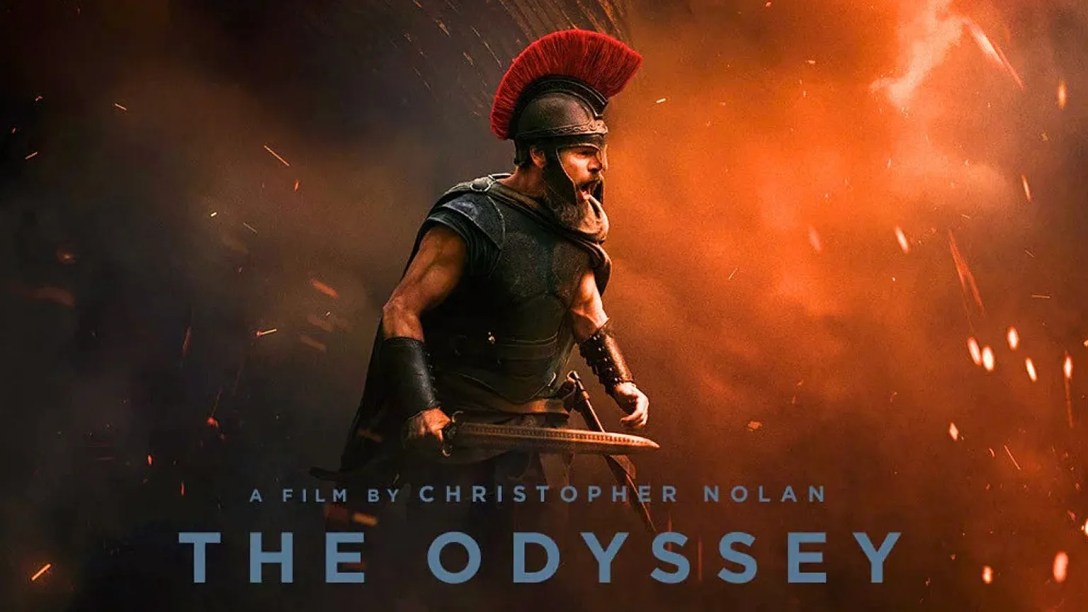
Every time a modern creator dares to reinterpret a classic epic, a predictable chorus of purists cries foul, accusing them of cultural sacrilege. We see it with every major adaptation, and the intense debates surrounding recent, psychologically dark cinematic reimaginings of the Odyssey—such as the viral concepts imagining a Christopher Nolan-helmed version—are no exception.
But this obsession with “absolute fidelity” to a classical myth is a historical paradox.
If we look closely at the foundation of Western literature, Ulysses (Odysseus) is arguably the most rewritten, adapted, and “betrayed” character of all time. To honor a classic after three millennia, you cannot treat it like an embalmed relic in a museum. You have to have the courage to betray it.
The Illusion of “Fidelity”
Before it was ever fixed into written text, the Odyssey was a living, breathing oral tradition. Bards altered and emphasized different episodes depending on the city they were performing in and the audience they faced. There was never an “authorized original version.”
Even the ancient Greeks constantly subverted their own sacred stories. In the 5th century BCE, the Athenian playwright Euripides wrote a tragedy claiming Helen never actually went to Troy, but spent the entire ten-year war hiding in Egypt while armies slaughtered each other over a phantom made of clouds. Nobody accused him of heresy; rewriting the myth was the highest form of intellectual engagement.
Since then, every era has molded Ulysses to reflect its own geopolitical and existential anxieties:
- For Virgil and the Romans, who saw themselves as descendants of the defeated Trojans, Ulysses was not a hero but a cruel war criminal—the deceitful inventor of the Trojan Horse.
- For Dante Alighieri in the 14th century, he was the pioneer of intellectual hubris, a man who abandoned his familial duties to sail past the Pillars of Hercules and challenge the limits of human knowledge.
- For the Victorian poet Lord Tennyson, he was the embodiment of the British Empire’s restless, expansionist spirit.
Today, a modern retelling cannot simply be a triumphant fairytale about defeating monsters. Through a 21st-century lens, it inevitably becomes a story about Post-Traumatic Stress Disorder, the moral collapse of empires, and the crushing, isolating weight of survival.
Achilles vs. Ulysses: The Hero for a Broken World
To understand why Ulysses translates so perfectly to the anxieties of modern cinema, we must contrast him with the other great titan of Greek mythology: Achilles.
Achilles is a monolith. He is the demigod of absolute, binary glory (kleos). His worldview is brutally simple: you either win in a blaze of absolute triumph, or you die young, beautiful, and remembered forever. He is the perfect archetype for traditional, sweeping Hollywood epics (like Wolfgang Petersen’s Troy), where the battlefield is clear and honor is measurable in blood.
But in a modern era defined by asymmetric warfare, institutional collapse, and moral gray areas, the pure warrior who dies a glorious death feels obsolete, if not entirely unrelatable.
Ulysses, by contrast, is polytropos—the man of many turns, the shape-shifter, the liar, the survivor. Ulysses does not get the mercy of a beautiful death on the battlefield. He is forced to survive, which means he is forced to compromise his morals, deceive his enemies, and make impossible choices. He is the hero of survivor’s guilt. In a modern world, we do not need the pure hero who perishes in battle; we need the broken man who has to figure out how to live among the ruins he himself helped create.
Anatomy of a Modern Adaptation
When we transpose a Bronze Age epic into a modern cinematic framework, the narrative architecture must radically shift. Rather than a straight translation, the mythological elements are deliberately stripped down to expose the human core of the story:
- The Protagonist: In the Homeric text, Ulysses is a glorious master of guile, and the Trojan Horse is a badge of military genius. Through a modern lens, he becomes a traumatized veteran, viewing the Horse as a war crime and an original sin that haunts him.
- The Gods: In the epic, gods are tangible, physical entities who intervene directly. In modern adaptations, they are internalized and secularized, functioning as psychological projections, hallucinations, or the unrelenting voice of a guilty conscience.
- Narrative Structure: Homer uses a linear flashback at the civilized Phaeacian court. Modern reimaginings often cut the Phaeacians entirely, relying instead on non-linear, fragmented editing to mimic the disorientation of trauma.
- Monsters & Magic: The classical Cyclops is defeated by a clever linguistic pun (“Nobody”). Modern versions favor visceral, desperate fights for survival and replace magic with substance abuse—such as Calypso using Lotus flowers to drug Ulysses into amnesia.
- The Climax: The original text concludes with the divinely sanctioned slaughter of the suitors and Ulysses reclaiming his throne. A modern take reframes this as a brutal, traumatic bloodbath, ending with Ulysses realizing he is too broken by war to govern in peacetime.
These deviations are not “mistakes.” They are deliberate choices meant to translate ancient archetypes into a language the modern world understands.
The Original Sin and the Death of Diplomacy
To understand the modern resonance of Ulysses’ journey, we must look at the starting point of his trauma. In our popular imagination, the wooden horse is celebrated as a stroke of tactical genius. In the context of the ancient world, it was an apocalyptic sacrilege.
The Achaean (Greek) civilization did not merely rely on brute military force; it was held together by the sacred laws of Zeus Xenios, the divine protector of guests, travelers, and diplomatic oaths. Xenia (hospitality) was the archaic equivalent of modern international law. It was the only invisible net that prevented rival, heavily armed city-states from slaughtering each other on sight.
The Trojan Horse destroyed this principle at its root. It was disguised as a religious offering. It transformed the sacred act of surrender into a literal Trojan horse: the guest who slits your throat in the dark after you generously open your city gates.
When a “superior” civilization uses absolute violence and deceit to win a war of attrition, it poisons the very rules that guarantee human coexistence. The gods do not turn their backs on the victorious Greeks out of pity for Troy; they do so because the Greeks have broken the moral order of the world.
There is a chilling historical parallel here. The mythical fall of Troy coincides with the actual Late Bronze Age Collapse (around 1200 BCE). In a matter of decades, the Eastern Mediterranean plunged into chaos. Waves of raiders swept away palaces and archives, ushering in centuries of barbarism. The world Ulysses navigates on his way home is a map of this regressed, post-apocalyptic reality.
The parallel with contemporary superpowers is impossible to ignore. When an empire that claims to uphold a “rules-based international order” decides it is above those very rules, it commits its own Trojan Horse deception. As the Greek historian Thucydides recorded in his Melian Dialogue: “The strong do what they can and the weak suffer what they must.” Once the hegemon proves that international rules are just formalities to be trampled when convenient, diplomacy dies. It is replaced by the law of the jungle.
The Tragedy of the Lucid Leader: Stoicism and the Crooked Timber
As Ulysses navigates this broken world, the external monsters are ultimately less devastating than his deeply internal tragedy: the crushing solitude of the “just man” forced to lead a society of fools.
In the opening lines of the Odyssey, Homer defines Ulysses’ crew with a specific, unforgiving Greek word: nepioi. It translates to “infantile” or “foolish,” but its deeper meaning implies a fundamental inability to connect cause and effect. The nepioi are people entirely disconnected from the future, driven only by the impulses of the present tense.
Ulysses is plagued by an agonizing moral asymmetry. He thinks long-term, calculates consequences, and accepts immediate deprivation for future salvation. When the wind god Aeolus gives him a bag containing all the contrary winds to ensure a safe voyage home, Ulysses stays awake at the helm for nine straight days, refusing to trust anyone else with the ship’s survival.
But the moment he collapses from sheer physical exhaustion just off the coast of Ithaca, his men regress. Driven by petty jealousy and convinced he is hoarding gold, they rip the bag open, blowing themselves away from salvation. Later, they gorge themselves at Circe’s table without a second thought. Finally, they slaughter the sacred cattle of the Sun God out of immediate hunger, even though they have been explicitly warned it will seal their doom.
The true nightmare of leadership is not fighting monsters; it is the exhaustion of being a shepherd to a flock that actively sprints toward the slaughterhouse.
This dynamic perfectly mirrors the philosophy of the Roman Emperor Marcus Aurelius. Writing his Meditations on the brutal Danubian front, surrounded by a devastating plague and treacherous generals, the Stoic emperor diagnosed the exact same human mediocrity that broke Ulysses:
“Begin the morning by saying to yourself, I shall meet with the busybody, the ungrateful, arrogant, deceitful, envious, unsocial… they are so because they do not know what is good and what is evil.”
For the Stoic leader, indignity and anger at human foolishness are illogical. Aurelius famously noted that expecting a foolish person not to cause harm is like expecting a fig tree not to produce its juice. It is a biological necessity.
Ulysses’ journey is the painful process of learning this exact stoic truth. Initially, he believes his intellect (metis) can outmaneuver the stupidity of his men. He feels entirely responsible for their survival. But slowly, the grueling reality sets in: civilization is a razor-thin veneer. When pushed by hunger, fear, or greed, the majority of humanity will revert to a feral state.
Centuries later, Immanuel Kant would formalize this exact disillusionment with his famous maxim: “Out of the crooked timber of humanity, no straight thing was ever made.” Ulysses is desperately trying to build a straight path home, but he is working with crooked timber.
Accepting this is the most agonizing moment in a leader’s life. You must do your duty—navigating the ship, fighting the storms—without any expectation of gratitude or success. When Ulysses finally surrenders to the will of the gods and the ocean, it is not an act of religious piety; it is the profound relief of a man who finally drops the burden of trying to control an uncontrollable, flawed world.
The Laestrygonians: Not a Hollywood Invention
When audiences watch a modern cinematic adaptation featuring giant armored warriors massacring a fleet, the immediate reaction is often to roll our eyes at “Hollywood CGI bloat.” It feels like a fabricated action sequence thrown in purely for blockbuster spectacle.
But the nightmare of the Laestrygonians is actually one of the most brutal—and least known—chapters of Homer’s original epic.
While heavily glossed over in school textbooks, the Laestrygonians were a highly organized, militarized society of giant cannibals. In the text, they trap the Greek fleet in a narrow, inescapable fjord. Homer’s description is horrifyingly clinical: they stand on the cliffs, hurl massive boulders to smash the wooden ships, and spear the dying Greek veterans “like fish.”
In a matter of minutes, Ulysses loses eleven of his twelve ships and nearly 600 men. He only survives because his veteran paranoia compelled him to moor his ship outside the bay. Hearing the screams, he draws his sword, violently cuts his own mooring line, and escapes—abandoning hundreds of his comrades to be slaughtered.
A modern film might tweak the visual aesthetics of these giants, but the core horror is pure Homer. It is not a modern cinematic invention; it is a genuine mythological catastrophe, and the definitive archaic origin of Ulysses’ survivor’s guilt.
Penelope and the Trap of Modern Sensibilities
When adapting such raw, primordial trauma for modern audiences, storytellers often stumble by trying to forcibly inject 21st-century sensibilities into Bronze Age politics.
Take Penelope. In an attempt to give her a contemporary “girl-boss” moment, modern scripts might have her deliver a sweeping feminist monologue to the suitors about how the throne was meant for men, but she ruled the island better than any king for twenty years. While well-intentioned, this feels like an anachronistic corporate mandate rather than organic storytelling. It spoon-feeds the audience rather than respecting the source material.
The patriarchy of Mycenaean Greece was absolute; political and military sovereignty belonged strictly to the man with the spear. In the original text, when Penelope tries to speak in the great hall to ask a bard to change a sad song, her teenage son Telemachus publicly silences her, telling her to go back to her loom because “speech is the business of men.” Penelope obeys without a word.
But her true greatness in the epic does not lie in giving modern political speeches; it lies in her lethal, archaic intelligence (metis). She single-handedly holds off over a hundred armed, violent noblemen for years using the trick of the burial shroud.
Most brilliantly, she is the only person who outsmarts Ulysses himself. When he finally returns, bathed in the blood of the suitors, she does not naively fall into his arms. She coldly tests him, ordering her servants to move her marital bed out of the bedchamber. Ulysses explodes in anger, revealing that the bed cannot be moved because he carved one of its posts directly into a living, rooted olive tree. By tricking the ultimate trickster into revealing the secret of the bed, Penelope proves she is his absolute intellectual equal. Erasing this subtle, strategic brilliance to replace it with a contemporary soapbox speech diminishes the terrifying, quiet power she wielded in an incredibly hostile world.
The Open Sea as a Secular Purgatory
A truly modern, mature adaptation of the Odyssey recognizes that the hero cannot simply slaughter his enemies, reclaim his throne, and live happily ever after. A man who has orchestrated the sack of Troy, listened to his army be eaten alive, and murdered a hundred unarmed suitors in his own dining room is fundamentally broken. The cinematic climax of killing the suitors is not a triumphant restoration of order; it is a bloodbath that pollutes his own home.
Like Dante’s Ulysses, the modern hero must eventually leave Ithaca behind. But unlike Dante’s explorer, who sails away out of an insatiable, proud thirst for knowledge, the modern Ulysses leaves out of contrition. He abdicates the throne because he knows that a man stained by a lifetime of deceit and warfare has no place in times of peace.
He takes to the open ocean—perhaps this time with Penelope by his side—not to conquer new lands, but because the sea is the only neutral space left. It becomes a secular purgatory where a devastated conscience, stripped of all illusions about human nature, the glory of war, and the nobility of empires, can finally seek the one thing that has eluded him since he set sail for Troy: silence.
Discover more from Zera's Castle
Subscribe to get the latest posts sent to your email.

