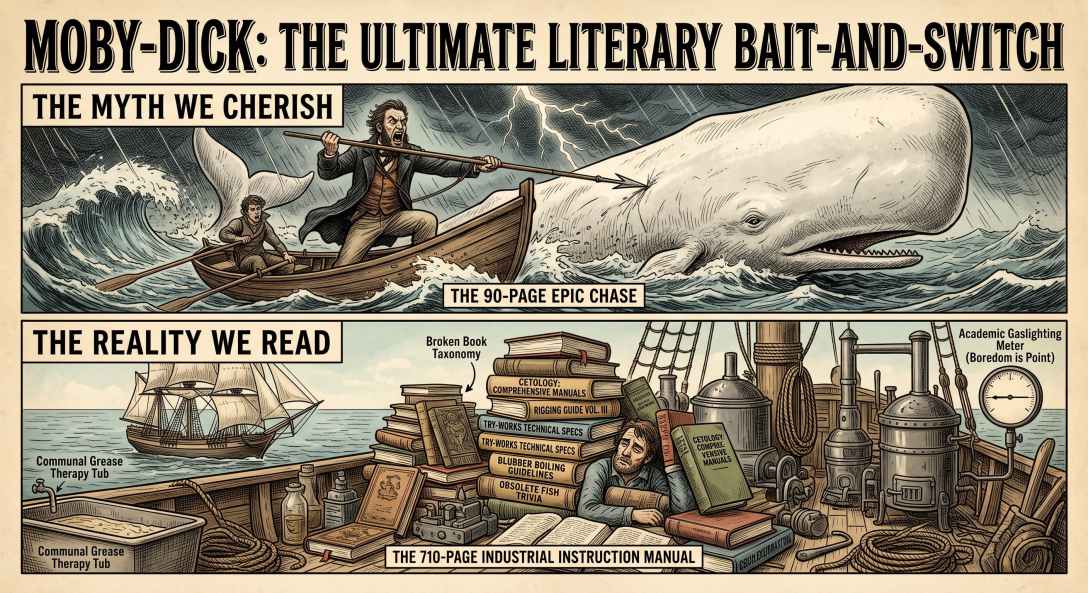
Let’s be brutally honest with each other for five seconds: nobody actually enjoys reading all of Moby-Dick.
We love the idea of it. We love quoting the opening line, “Call me Ishmael.” We love the cinematic imagery of a wild-eyed, peg-legged captain screaming defiance into a typhoon while hunting a phantom albino leviathan. In our collective cultural imagination, Herman Melville’s 1851 masterpiece is the ultimate nineteenth-century psychological thriller—a relentless, adrenaline-fueled story of revenge, madness, and the terrifying supremacy of nature.
Then, you make the fateful decision to actually crack the spine.
What happens next is the single greatest bait-and-switch operation ever pulled on the reading public. You strap in for a legendary sea chase, and instead, you get bludgeoned with six hundred pages of nineteenth-century naval plumbing, obsolete fish trivia, and step-by-step guides on how to boil animal fat without burning down a wooden boat.
The white whale isn’t a plot point; it’s clickbait. It’s time to call out the biggest literary scam ever pulled on readers, strip away two centuries of academic snobbery, and admit what we are all actually thinking: Moby-Dick is a disjointed, unedited, 800-page industrial instruction manual masquerading as a novel.
The 80% Filler Problem
Here is the dirty secret that high school English teachers and university professors prefer to gloss over: Captain Ahab’s hunt for the white whale accounts for barely twenty percent of the entire book.
If you take a literary scalpel and excise all the filler, the actual plot of Moby-Dick is razor-thin and moves at a breakneck pace:
- A drifter named Ishmael signs onto a whaling ship called the Pequod.
- Captain Ahab reveals to the crew that he is utterly insane and wants revenge on a specific white sperm whale that bit off his leg.
- The ship sails the oceans looking for it.
- They spot the beast.
- Three days of absolute chaos ensue, the ship sinks, everyone dies except Ishmael.
That’s it. That is a tight, brilliant, 90-page novella packed with tension, incredible dialogue, and Shakespearean tragedy.
So what exactly lives in the other seven hundred pages?
An industrial trade manual. You are essentially forced to read the internal training documentation of the Massachusetts Whaling Board of 1850. Melville doesn’t just set the scene; he handcuffs you to a barrel of whale fat and forces you to clock in for a three-year shift in real-time.
Welcome to the Open-Sea Meat Processing Plant
If you open Moby-Dick expecting epic poetry, prepare yourself for an avalanche of unedited, granular vocational tedium. Melville routinely halts narrative momentum dead in its tracks to drop chapters that feel like OSHA safety violations written in archaic prose.
Let’s look at the worst offenders that have broken the spirit of millions of readers:
- The Broken Book Taxonomy (Cetology): Early in the book, Ishmael decides to classify every known species of whale. Does he use modern biology? No. He proudly declares that a whale is simply “a spouting fish with a horizontal tail” and sorts them based on the physical dimensions of library books (Folio Whales, Octavo Whales, etc.). It’s a dry, weird joke dragged out across twenty agonizing pages.
- The Autopsy from Hell: Melville dedicates separate, hyper-detailed essays to every single body part of the beast. You will endure chapters on the exact texture of whale blubber, the mechanics of the caudal fin, the precise measurements of its skeletal ribs, and the pseudoscientific phrenology of the whale’s flat forehead. It’s like reading a veterinarian’s autopsy report.
- The Rigging & Boiler Manual: Want to know the exact tension of a hemp rope so it doesn’t accidentally sever your foot? Melville has a chapter for that. Want a breakdown of the masonry used to build brick furnaces (The Try-Works) on a wooden deck to boil blubber? Melville has a chapter for that, too.
- Communal Grease Therapy: In a chapter titled A Squeeze of the Hand, the crew sits around wooden tubs manually squeezing congealed lumps of sperm whale oil back into liquid form. This repetitive factory task somehow sends Ishmael into a bizarre, euphoric trance about universal human brotherhood through the magic of warm animal fat.
If you have a scientific or engineering background, you know how to read technical literature—you read it to solve real problems. When Melville dumps hundreds of pages of inaccurate Victorian natural history into a revenge tragedy, he isn’t expanding your mind. He’s just refusing to delete his research notes.
The Great Academic Gaslighting
Whenever a modern reader complains that this book is unreadable and ruins its own pacing, academia rolls out its favorite defense mechanism: high-grade intellectual gaslighting.
The apologetics always sound something like this:
“You just don’t get it! The boredom is the point. Melville’s relentless cataloging is a brilliant meta-commentary on the limits of human knowledge. The frustration and exhaustion you feel is an intentional artistic device to simulate the vast, inscrutable void of the cosmos!”
Let’s apply Occam’s razor to that claim.
If an author writes a book that is 80% boring to “simulate the feeling of boredom,” they haven’t executed a masterstroke of post-modernist genius—they’ve just written a bad book. If an artwork requires a 400-page academic thesis to convince you that your massive headache was actually an existential breakthrough, the artwork failed to deliver the goods.
Melville wasn’t playing 4D-chess with human epistemology. The biographical reality is much simpler. He was sitting isolated on his farm, fueled by manic creative energy, trying to capture his actual years as a sailor. He had a massive pile of firsthand vocational memories, zero editorial oversight, and an overwhelming urge to empty his entire brain onto the page. He didn’t have an editor brave enough to tell him, “Herman, cut the blubber.”
Worldbuilding Gone Wrong: The Tolkien Test
Some modern defenders try a different angle. “Melville was an early master of worldbuilding!” they argue. “He was creating an immersive simulation, just like fantasy authors do today!”
Fair enough. Let’s judge Moby-Dick strictly as an exercise in worldbuilding lore. Unfortunately, it still loses to the giants of the genre.
Take the ultimate gold standard of dense, lore-heavy literature: J.R.R. Tolkien’s The Silmarillion.
The Silmarillion is notoriously intimidating. It contains endless, exhausting catalogs of Elven family trees and geography. But here’s the critical difference: Tolkien’s lore is inherently epic.
When Tolkien pauses his story to list names, he is telling you about the fall of Gondolin, the theft of magical jewels, dragons leveling mountain ranges, and dark lords corrupting the earth. You are reading the sacred history of an enchanted world.
Melville’s lore doesn’t transport you to a mythic realm; it drags you into a floating slaughterhouse. It is the literary equivalent of pausing The Lord of the Rings right before the Battle of Helm’s Deep to force the reader through an eighty-page manual on the precise metallurgy of Uruk-hai armor and the proper way to grease an iron gate.
Tolkien builds a mythology. Melville writes an industrial inspection report.
The “Originality” Illusion
Another desperate defense is that Melville was a radical pioneer who broke the traditional rules of the novel decades before James Joyce and the Modernists. Moby-Dick is a masterpiece, they say, because nobody had ever dared to mix fiction with technical reality before.
Except, that is historically false.
Stuffing fiction with dry technical documentation and disruptive non-fiction essays was an established European literary trick for over a century before Ahab ever set sail:
- Daniel Defoe (Robinson Crusoe, 1719): Built the foundation of realism out of boring inventories. Crusoe spends entire chapters painstakingly explaining how to carve a wooden shovel and cure goat hides.
- Jonathan Swift (Gulliver’s Travels, 1726): Loaded his satire with verbatim nautical jargon lifted directly from sailors’ handbooks, alongside exact mathematical calculations of a giant’s caloric intake.
- Laurence Sterne (Tristram Shandy, 1759): The undisputed king of narrative sabotage, who constantly derailed his own story to insert real treatises on military bastions and eighteenth-century obstetrics.
- Honoré de Balzac (Lost Illusions, 1837): Just fourteen years before Melville, Balzac dropped multi-chapter breakdowns of industrial printing presses and commercial credit fraud straight into the middle of a romance.
Melville didn’t invent the technique. He simply applied it to the extraction of whale oil and cranked the dial until the narrative broke under its own weight.
How a Flop Became a Sacred Cow (And The Hollywood Test)
If Moby-Dick is such a bloated text, how did it become the undisputed heavyweight champion of American literature?
Simple: historical marketing and national insecurity.
When the book came out in 1851, it was an absolute disaster. It baffled reviewers, readers hated it, and it effectively destroyed Melville’s career. He died in 1891, broke and forgotten, working as a customs clerk in New York.
The novel was rescued by academics during the “Melville Revival” of the 1920s. Following World War I, American critics realized the country lacked a foundational cultural epic to rival Europe’s heavyweights (Dante, Shakespeare, Goethe). They dug through the national archives looking for a forgotten giant and found Moby-Dick.
It was perfect: massive, brooding, and crucially, so chaotic and disjointed that academics could write dissertations about its hidden meanings for the next hundred years. They rebranded his lack of editing as “avant-garde genius.”
But the ultimate proof of the novel’s structural failure is Hollywood. Look at every single film or miniseries adaptation of Moby-Dick in history. What do they all have in common? They uniformly throw away 85% of the book. Directors keep Ahab, the whale, and the climactic ocean duel, quietly burning every single chapter on blubber rendering. Filmmakers know what academics refuse to admit: nobody shows up for the oil factory.
Time to Name the Beast
Buried deep beneath the blubber of Moby-Dick sits a genuinely magnificent ninety-page tragedy. Ahab’s monologues crackle with terrifying psychological intensity, and the final three-day chase against the white whale is pure adrenaline.
But having brilliant raw material doesn’t excuse abandoning the basic duties of storytelling.
A masterpiece isn’t measured by how many interesting digressions you can cram between two covers; it’s measured by how those pieces work together to create an unforgettable experience. Moby-Dick buries a brilliant story under a mountain of trivia, dares you to complain, and relies on two centuries of academic peer pressure to keep you from admitting the obvious.
So the next time someone tells you that Moby-Dick is the greatest novel ever written, don’t feel guilty. Just hand them the book, open to chapter 32, and tell them to enjoy twenty pages on whale taxonomy.
The emperor has no harpoon.
What about you? Have you ever tried to read Moby-Dick and given up? What is a universally praised “classic” masterpiece that you absolutely couldn’t stand? Drop a comment below and let’s bust some literary myths together.
Discover more from Zera's Castle
Subscribe to get the latest posts sent to your email.

