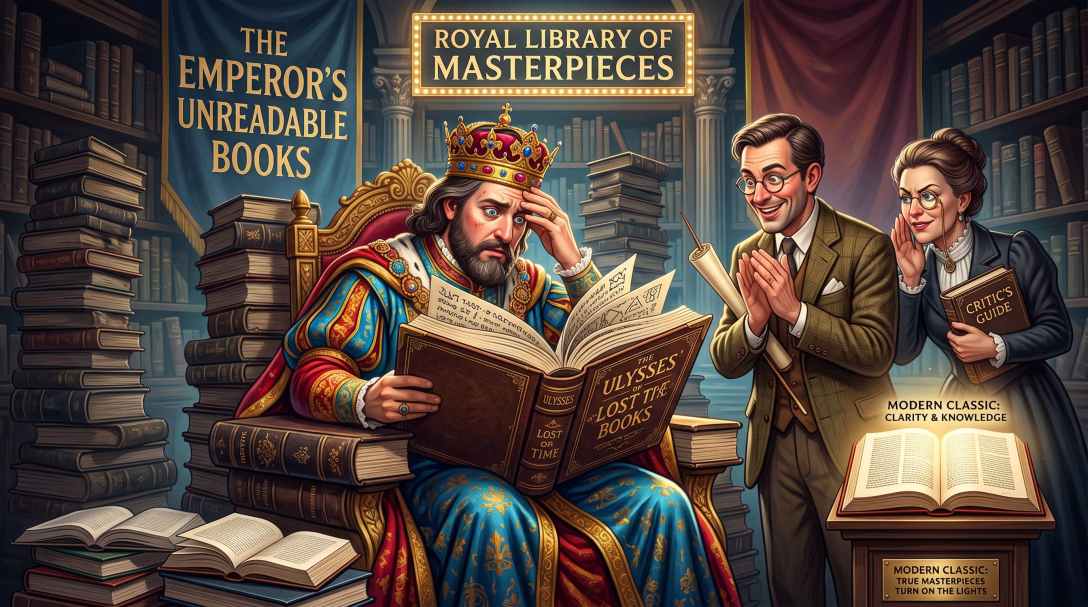
Look at your bookshelf right now. I guarantee there is a book sitting there, silently judging you.
You know the one. It’s on every “Greatest Books of All Time” list. You bought it because you wanted to absorb culture, challenge your mind, and understand the human condition. You sat down with your coffee, opened James Joyce’s Ulysses or Marcel Proust’s In Search of Lost Time, and prepared to be transformed.
Instead, you experienced an almost universal, silent defeat.
You read ten pages. Your eyes tracked perfectly over the words. Yet, when you reached the bottom of the page, you realized your brain had retained absolutely nothing. No plot to anchor you. No clear action to visualize. No actionable ideas to extract.
You closed the book feeling frustrated, assuming you simply weren’t smart enough to grasp the genius everyone else seemed to see.
I am here to tell you a cynical, liberating truth: You didn’t fail the book. The book was never designed to be read by you.
There is a colossal, systemic gaslighting at the heart of literary culture. We have been taught to treat hyper-complex, opaque avant-garde novels as the absolute pinnacle of human storytelling. But if we strip away the academic smoke and look at these works through the lens of engineering and information theory, a very different picture emerges.
These books are not the highest form of literature. They are the equivalent of proprietary code written by a developer who refuses to leave documentation—championed by a guild of academics who have built a lucrative industry out of charging you to decrypt it.
Here is why it’s time to stop feeling guilty, and how to entirely rethink what makes a book a “masterpiece.”
Why You Are Trying to Commute in a Concept Car
Ask an automotive engineer to name the most revolutionary car ever built, and they might point to a highly experimental concept vehicle. It’s made entirely of carbon fiber, has no headlights, and requires a team of mechanics just to start the engine.
It is an astonishing piece of machinery. But if a consumer magazine put that exact vehicle at the #1 spot on a list of “Best Cars for Your Daily Commute,” it would be institutional malpractice.
The literary world commits this exact category mistake every single day.
When critics place Ulysses at the top of the pantheon, they aren’t evaluating it as a finished consumer product meant to deliver an engaging experience. They are evaluating it as Research & Development.
Joyce pushed the machinery of language to its breaking point to see what it could withstand. He stripped away the chassis of traditional plot to test if a narrative could run purely on the fumes of the subconscious.
The experiment was a monumental success. Modern cinema, television, and contemporary fiction routinely scavenge the parts Joyce manufactured in that laboratory and polish them into stories we actually enjoy.
But a laboratory prototype is not a finished product. You do not owe your evenings to a lab experiment just because it was historically important.
The Difference Between a Genius and a Game Master
The standard defense of avant-garde literature is that it isn’t random; it is highly engineered.
This is true. Joyce didn’t just smash his hands on a typewriter. Every seemingly disjointed syllable has a verifiable root. But we must distinguish between two entirely different types of complexity:
- Arbitrary Complexity: When an author writes a novel, they are a god in their own universe. If they decide that a passage in archaic English must cross-reference a medieval theological debate and a dirty limerick simultaneously, they just write it. The author invented the maze, hid the cheese, and is now being applauded for proving the maze is difficult to navigate.
- Constrained Complexity: When an engineer, a physicist, or a biologist writes a theoretical paper, they are not allowed to invent the rules. They are in a fistfight with the uncompromising reality of the physical universe. They must account for gravity, thermodynamics, and material fatigue.
Extracting elegant, universal laws from the chaotic noise of the real world requires a level of intellectual rigor that dwarfs the act of inventing a linguistic puzzle.
Solving a real-world problem is inherently superior to constructing an artificial enigma.
Yet, the cultural elite continues to reward the architect of the artificial maze while dismissing the engineer who builds a bridge that actually holds weight.
How “High Art” Weaponized Confusion
In science and engineering, a model is considered powerful if it possesses invariance.
If you can take the laws of thermodynamics and express them in English, translate them into Mandarin, write them as equations on a chalkboard, or map them into a software simulation—and the underlying truth remains intact—you have captured something profoundly real. The language is just a transparent vessel; the signal is robust.
Literature flipped this metric upside down to protect itself.
Before the scientific revolution, the humanities and the sciences were the same thing: humans writing texts to describe the world. But as science began producing models of reality that were infinitely more precise and useful, the literary establishment faced an existential crisis.
To survive, literary critics executed a brilliant defensive maneuver: they turned their greatest weakness into a badge of nobility.
- If a text was clear, transparent, and could be summarized without losing its essence, they labeled it “vulgar” or “merely functional.”
- If a text was so fragile that changing a single word destroyed its meaning—if it could not be paraphrased or translated—they crowned it “High Art.”
They built a fortress around information fragility. The inability of a text to reliably transmit a clear signal was rebranded as “poetic function,” allowing the literary world to avoid competing with the hard sciences entirely.
The Aristocratic Snobbery of the Canon
Why do we refuse to call a brilliant engineering manual, a flawlessly argued economics paper, or a foundational computer science thesis “literature”?
The barrier isn’t one of quality. It is a remnant of ancient classism.
In ancient Greece and Victorian England, the ruling classes did not have to work. Consequently, they developed a deep cultural disdain for any knowledge that had a practical, manual, or commercial application. True aristocratic knowledge had to be aggressively useless.
- Learn geometry to build a better aqueduct? You are a laborer.
- Learn geometry to contemplate the divine perfection of spheres? You are a philosopher.
This snobbery is alive and well today. If a book teaches you how to manage a crisis or how a silicon chip functions, it is relegated to the “technical manual” pile. But if a book spends a thousand pages dissecting the neuroses of a Parisian aristocrat without yielding a single actionable insight, it is a masterpiece.
Furthermore, this system sustains the academic guild. A brilliantly structured scientific paper explains itself. The academic industry, however, requires opaque, infinitely interpretable texts to justify its own existence. They champion the unreadable because the unreadable guarantees them a monopoly on the translation.
Read to Turn on the Lights (Not to Sit in the Dark)
It is time we stop judging our reading habits by the metrics of a guild that benefits from our confusion. We need to strip away the academic smoke and return to the original, etymological root of the word.
Litteratura simply means anything written with letters. It is the encoding of human thought and knowledge into symbols.
By that definition, we are living in a golden age of literature—we are just looking for it on the wrong shelves.
When Claude Shannon wrote A Mathematical Theory of Communication in 1948, he didn’t just write a technical paper; he authored the foundational text of the digital age. When Charles Darwin wrote On the Origin of Species, he delivered a narrative about the interconnectedness of life that is more sweeping and dramatic than any epic poem.
A text that elegantly decodes the chaos of reality, provides you with robust mental models, and transmits its signal clearly across time and space is not a “mere manual.” It is the highest form of writing the human mind can achieve.
The next time you close a celebrated classic after ten pages because it feels like a pointless slog, do not feel guilty.
Put the prototype back in the laboratory where it belongs. Pick up a book—whether it is a tightly plotted speculative novel, a brutal work of historical non-fiction, or a masterful scientific treatise—that actually respects your time and rewards your intellect.
True masterpieces do not hide in the dark, demanding you learn their secret language. They turn on the lights so you can finally see the room.
Discover more from Zera's Castle
Subscribe to get the latest posts sent to your email.

