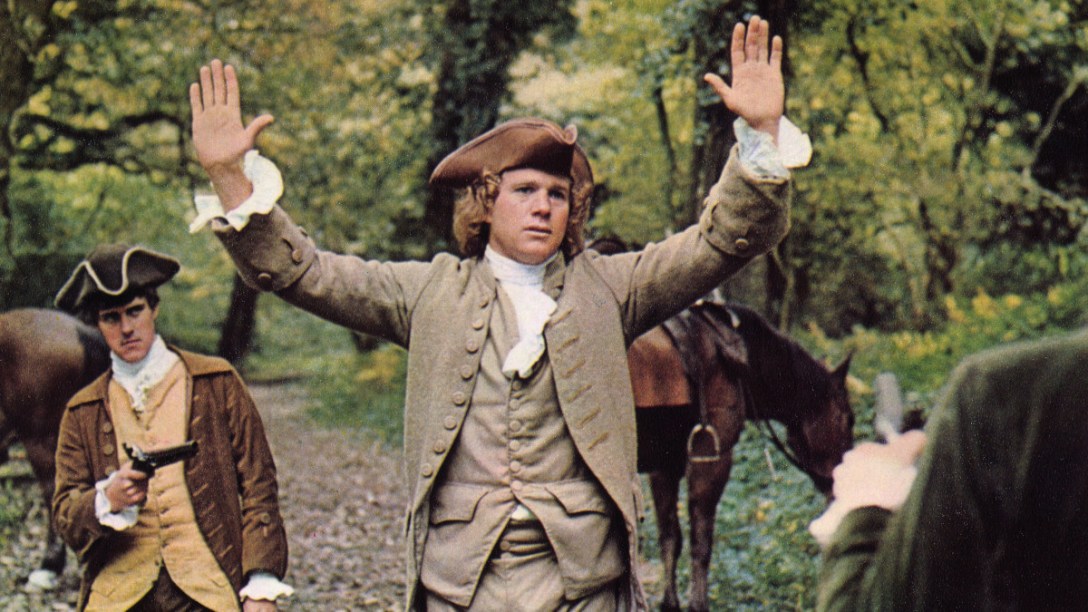
There are films you watch, and there are films you inhabit. Stanley Kubrick’s Barry Lyndon unequivocally belongs to the latter category. Watching it for the first time is an almost otherworldly experience: you step into an art gallery where 18th-century paintings suddenly come to life. Every frame is a canvas, every movement a choreography, every silence dense with meaning. It is a monumental work that, as we discovered in a long and passionate chat, left some critics perplexed upon its 1975 release, who labeled it as cold, slow, a “wax museum.” And yet, time—the film’s true protagonist—has done it justice, consecrating it as one of the absolute pinnacles of cinema history.
But why is Barry Lyndon considered such a complete masterpiece? What lies beneath its formally perfect and frigid surface? In the following lines, we will try to retrace the steps of our conversation, exploring the technical, narrative, and philosophical reasons that make this film an unforgettable experience.
Cinema Becomes Painting: A Revolutionary Aesthetic
The first impact of Barry Lyndon is purely visual. It is impossible not to be stunned by the formal beauty of every single scene. Kubrick, with his legendary perfectionism, did not merely “recreate” the 18th century: he literally painted it with the camera. Together with his director of photography, John Alcott (who won a well-deserved Oscar), he thoroughly studied the art of the era, drawing direct inspiration from painters like William Hogarth for social satire, Thomas Gainsborough for aristocratic portraits, and John Constable for melancholic landscapes.
The result is a work in which light itself becomes a character. We spoke at length about the famous legend of the Zeiss Planar f/0.7 lenses, instruments developed for NASA that Kubrick procured to be able to shoot interior scenes illuminated solely by the flickering light of candles. This was not a mere technical feat but a radical aesthetic and philosophical choice. The absence of artificial light immerses the viewer in a pre-electricity world, restoring an atmosphere of intimacy and an almost documentary-like realism. Those golden, silent, and fragile scenes physically transport us into the drawing rooms and bedrooms of two and a half centuries ago.
Similarly, natural light dominates the daytime scenes. Sunlight, often filtered through the cloudy skies of Ireland or the large windows of lavish mansions, is the true source of illumination. This approach, though supported by an “invisible” use of artificial lights to enhance and control the effect, generates a tangible realism.
To this masterful management of light is added another of the film’s hallmarks: the signature slow zoom-out. A scene often opens on a detail—a face, hands playing cards, an object—before the frame slowly widens to reveal the surrounding environment. As we observed, this is not a mere stylistic quirk. It is a poetic statement: the individual, with their passions and petty ambitions, is progressively absorbed, almost nullified, by the social context, by the rigid rules of etiquette, by the vastness of History. Man is but a small figure in an immense and immutable painting.
The Architecture of a Foretold Fall
If the aesthetic of Barry Lyndon is that of a painting, its narrative structure is that of a great 18th-century novel, but told with an almost divine coldness. The choice of an omniscient and detached narrator is a stroke of genius. This narrator already knows everything and does not hesitate to reveal crucial plot points in advance: he tells us that a marriage will be unhappy, that a son will die, that Barry’s fortune is destined to vanish.
This device strips the viewer of classic suspense (“What will happen?”), focusing them entirely on the “How” and “Why” of events. The film thus transforms into a reflection on Fate, on ineluctable Destiny. Every victory for our protagonist immediately appears ephemeral, each of his social climbs just one more step toward a fall already written. We are spectators not of a drama, but of a foretold tragedy, and this generates a sense of profound and bitter melancholy.
Contributing to this feeling is the deliberately slow, almost meditative pace. It’s a rhythm that can be disconcerting at first but proves necessary to allow us to “inhabit” that world. Kubrick forces us to abandon modern frenzy and enter a different temporality, where social rituals, duels, conversations, and even silences have a weight and a duration that we have forgotten today. It is a slowness that serves to emphasize the inevitability of events, like the slow procession of a funeral ceremony that lasts an entire lifetime.
The Tragedy of the Social Climber
Beneath the powdered wigs and lavish costumes, Barry Lyndon is a ruthless analysis of class structures and human ambition. Redmond Barry is an outsider, a penniless but proud young Irishman, desperately trying to enter a world that can never truly belong to him. He is willing to do anything: he fights in a war, becomes a spy, transforms into a professional cardsharp, and finally marries for his own interests one of the wealthiest and most titled women in the kingdom, Lady Lyndon.
He acquires the manners, the clothes, the luxury, the lifestyle. But, as we rightly observed in our chat, none of it is enough. The nobility of the 18th century is not a matter of wealth or behavior, but of blood. It is a closed system, almost “racist” in its essence, based on a concept of purity of lineage. No matter how high Barry may climb, to the aristocracy that surrounds him, he will always and only be a “parvenu,” a fortunate Irish bumpkin.
This exclusion is embodied by his stepson, Lord Bullingdon, who from the very beginning identifies him not just as an unwelcome stepfather but as a usurper, a contaminating element. His hostility is not just personal; it is the ideological defense of an entire caste. The most pathetic moment in Barry’s journey is perhaps his attempt to spend a fortune to buy a noble title—the final illusion that money can finally buy what blood has denied him. But the system is designed to reject him. It is an impregnable fortress.
The Two Duels: From Romanticism to Infamy
The existential and moral arc of Barry Lyndon is marked by two duels, two mirror-image moments that signal the beginning and the end of his ascent. And, as you acutely summarized, these two confrontations represent two very different defeats.
The first duel, against Captain Quin for the love of his cousin Nora, is the perfect representation of “Romanticism losing to Cynicism.” The young Barry is a romantic hero: impulsive, driven by passion and a naive sense of honor. He challenges a powerful man without calculating the consequences. But his victory on the field is a farce. He is defeated by the cynicism of his own family, who deceives and exiles him to secure an economically advantageous marriage. His youthful idealism shatters against the harsh reality of a world governed by money.
The second duel, at the end of the film, against Lord Bullingdon, is much more complex. Here, as you said, we witness “Nobility (of spirit) losing to Infamy.” The Barry who faces his stepson is no longer the impulsive boy of the past. He is a man who has lived, fought, loved, and suffered the greatest loss of all, that of a son. When, on his turn, he deliberately fires into the ground, he performs an act of pity, of superior humanity. He sees before him not an enemy, but a terrified boy. That is a gesture of true nobility of spirit, a greatness that no noble title could ever bestow. But this nobility is punished. Bullingdon, without hesitation, shoots him, winning the confrontation in a manner that is formally correct but morally infamous.
Barry’s tragedy is all here: he is punished first for his naivety and then for his achieved moral maturity. In that ruthless world, there is no place for either romantic idealism or true greatness of spirit.
Figures of a World in Exile
Moving around Barry are figures who, like him, live a form of exile. His encounter with the Chevalier de Balibari is a meeting of two kindred spirits. Both Irishmen, outsiders by definition in continental Europe, they are condemned to a nomadic existence, living by their wits on the fringes of a world that tolerates but will never accept them. The Chevalier is a mentor who teaches Barry not morality, but the art of survival—the cynicism necessary to exploit a hypocritical system from within.
Barry’s mother is also a key figure in his destiny. Driven by a fierce love and boundless ambition for her son, her presence proves to be both a support and a cause of his ruin. Once installed in the wealthy Lyndon estate, her need for control and her pragmatic, almost peasant-like mentality clash with the unwritten rules of the aristocratic world. By trying to protect the estate from her son’s lavish spending, she ends up sabotaging the very quest for status that required ostentation and prodigality, accelerating the family’s isolation and making their nature as outsiders even more evident. Her protective love transforms into a gilded cage that contributes to the final catastrophe.
Conclusion: They Are All Equal Now
At the end of this long journey, after the rise and fall, after the victories and humiliations, a cold title card seals the fate of all the characters:
It was in the reign of George III that the aforesaid personages lived and quarrelled; good or bad, handsome or ugly, rich or poor, they are all equal now.
It is the perfect epitaph for a film that is a profound meditation on the vanity of human ambitions, the transience of life, and the inescapability of time. The breathtaking beauty of the images, the solemn music of Händel and Schubert, the story of a man who wanted to be more than he was—it all converges on this simple, terrible truth. Before the indifferent gaze of History, our battles, our passions, and our sufferings are nothing but dust. And perhaps, the greatness of Barry Lyndon lies precisely here: in having made us inhabit that dust for three hours, rendering it lavish, tragic, and unforgettable.
Discover more from Zera's Castle
Subscribe to get the latest posts sent to your email.
 Zera's Castle